From fast AI output to a scalable product system

Vicino AI, an AI-native marketing workspace.

Role

Design Lead
0→1 Product

Time

2026

Impacts

As Design Lead at Vicino, I helped turn a collection of AI features into a connected marketing product—and built an AI-native design workflow to design it faster.

What is Vicino?

One connected marketing loop.

Vicino is an AI-native marketing workspace connecting strategy, execution, and learning.
Strategy → Campaign → Creative → Performance → Learn, in one connected loop.

What I walked into

But this isn’t what I walked into.
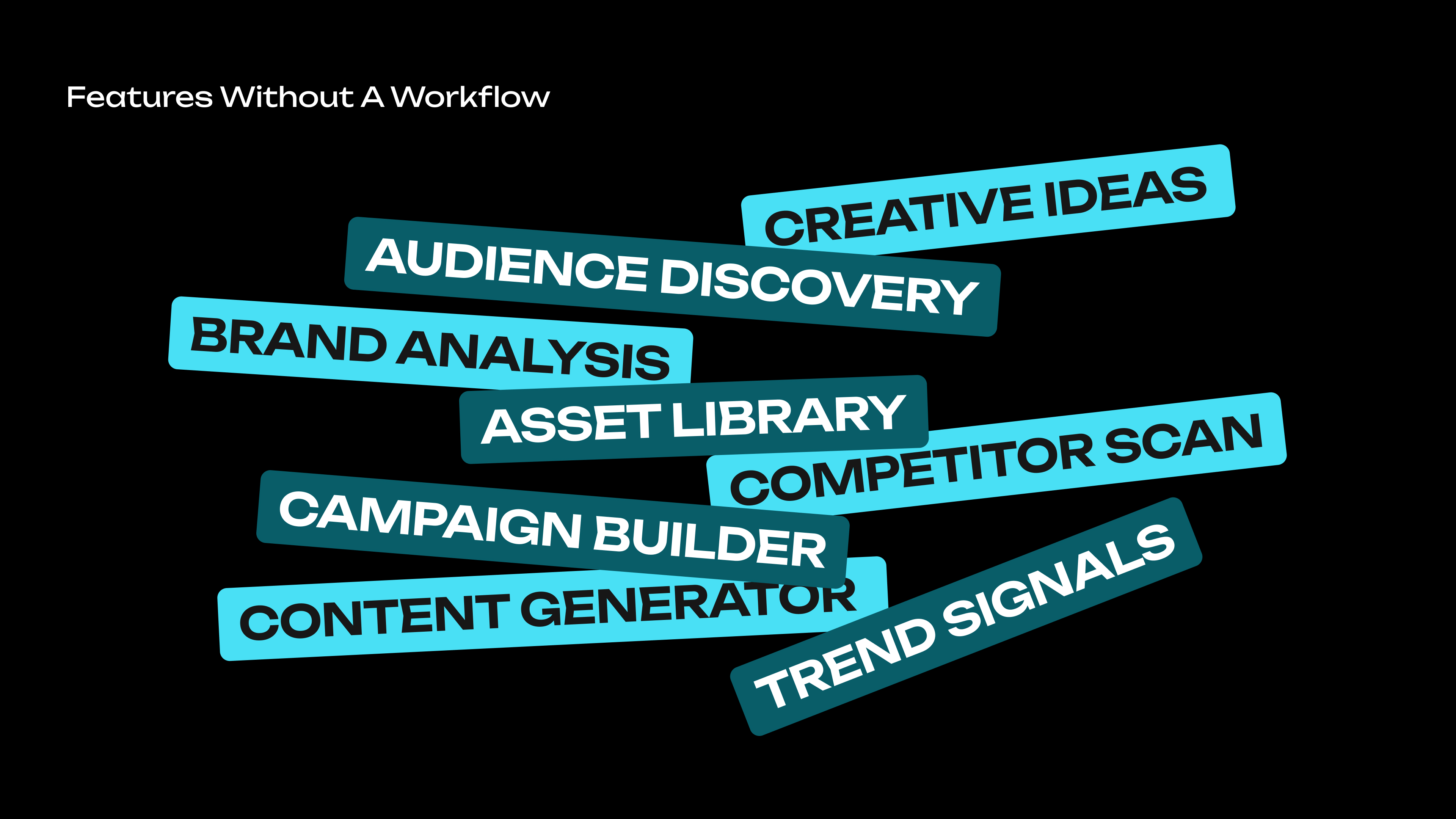
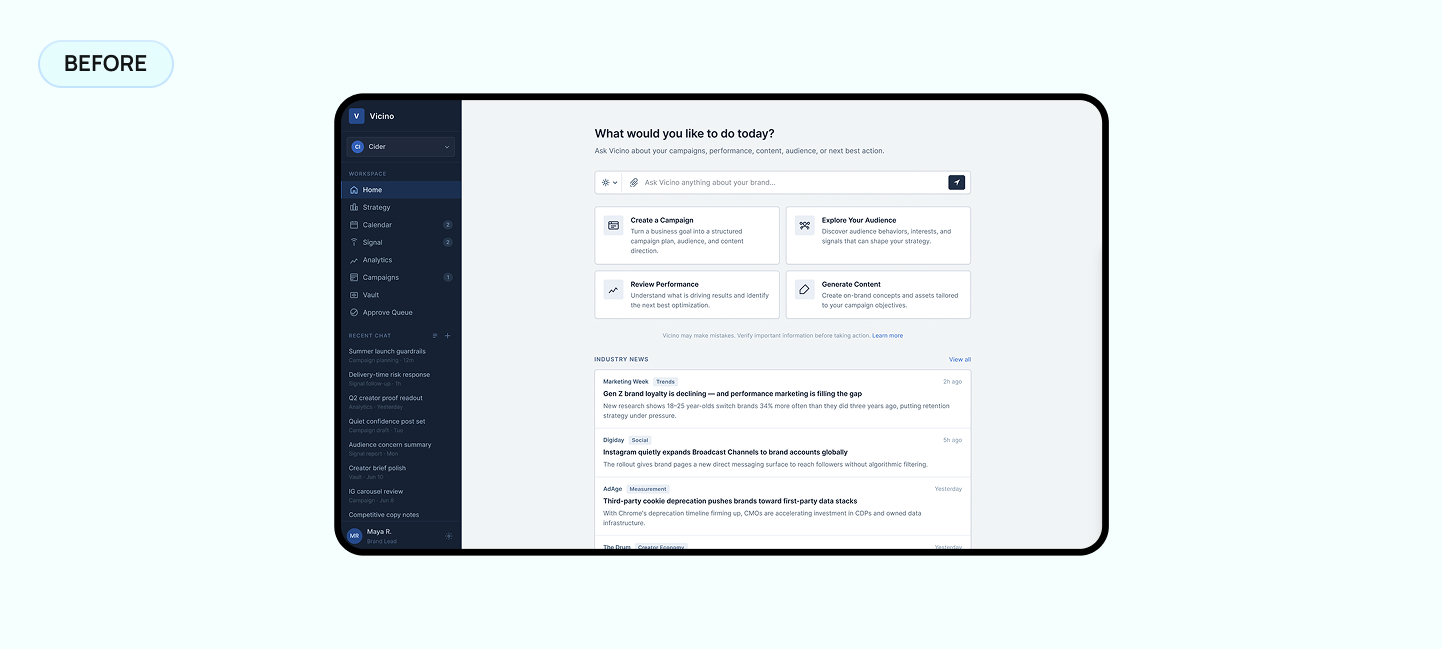
The problem wasn’t a lack of AI features. The features didn’t add up to a product.
Disconnected features, repeated context, and inconsistent product patterns in the early product.

Understanding the workflow

I started with how marketers actually work.
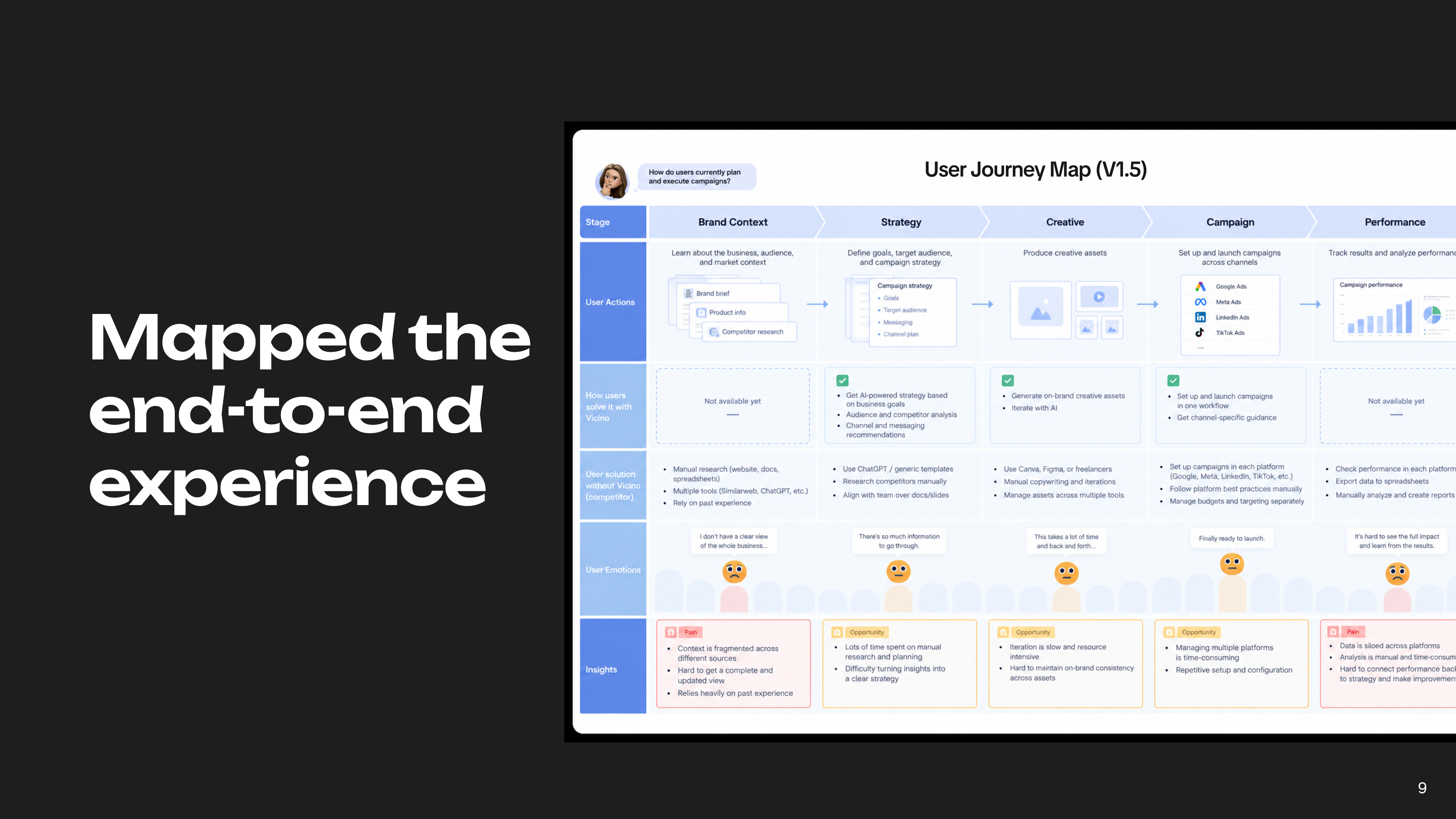
Marketing wasn’t a collection of AI tasks. It was one continuous loop.
User journey map: brand context, strategy, creative, campaign, performance
End-to-end marketing journey map, from goal to learning.

Build, Test, Learn

From product structure to a testable prototype.

I used AI to quickly turn the initial architecture into a working prototype, then tested it with marketers before investing in visual polish.
Using AI to turn the initial product structure into a working prototype.

Testing showed that marketers didn’t work in a fixed sequence—they moved between strategy, campaign, creative, and performance as decisions evolved. More importantly, the value of AI wasn’t simply generating more content, but carrying the right context across that workflow.

That shifted the product from a linear AI flow to a connected marketing workspace.

The Solution

One context. One connected workflow.

Set the foundation

Defining design standards from scratch.

Vicino had no shared design guidelines. Before scaling the product, I established the design standards every screen would follow.
Vicino’s design system: the shared standards behind every screen.

Understand the brand

Infer what we can. Ask only what matters.

I rapidly explored different ways to capture context—from structured questions to AI interviews and automatic research—then converged on a lightweight onboarding experience.
Early onboarding explorations: multiple directions prototyped in parallel.
Final onboarding: Connect → Analyze → Ask → Review & Approve.

Carry context into action

Start with context, not another prompt.

Brand, audience, goals, and strategy carry directly into campaign creation, so users don’t have to repeatedly explain what the system already knows.
Campaign creation starts from the brand, audience, goals, and strategy already in context.

Learn from every result

Performance feeds the next decision.

Campaign results become new context for recommendations and future actions, closing the loop between planning, execution, and learning.
Strategy → Campaign → Creative → Performance → Learn ↺

Design Engineering

Faster building needed a stronger system.
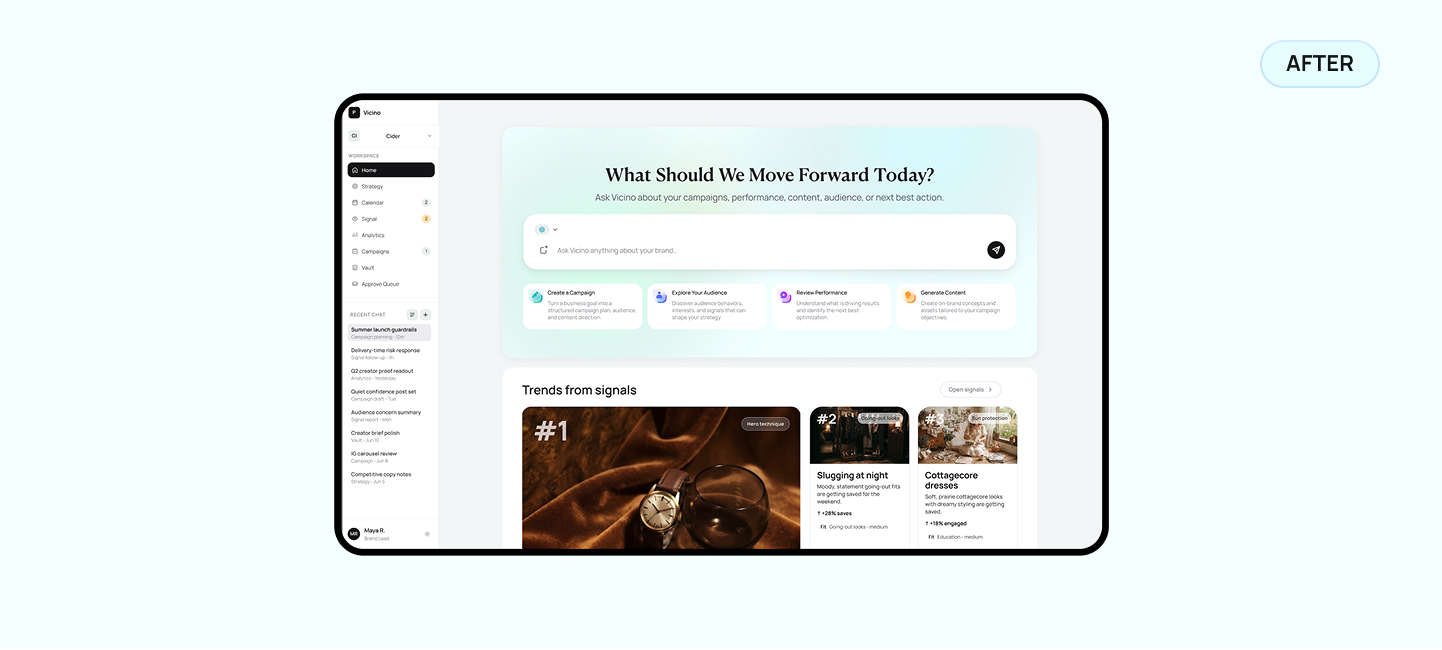
As AI accelerated my prototyping workflow, I consolidated repeated UI decisions into shared tokens, components, patterns, and layout rules.
Image comparison slider. Before: Earlier Vicino prototype interface. After: Consolidated Vicino product interface. Drag or use arrow keys to compare.
Consolidated Vicino product interface
Before and after consolidating repeated UI decisions. Drag to compare.

Looked consistent

risk
status
Different structureDifferent statesOne-off styling

Built as a system

Header
Content
Status
Action
Shared CardShared ButtonShared StatusShared Interaction

Visual similarity was not enough. The structure had to become reusable.

But most of my prototypes no longer started in Figma, so I made the Design System readable by AI too.
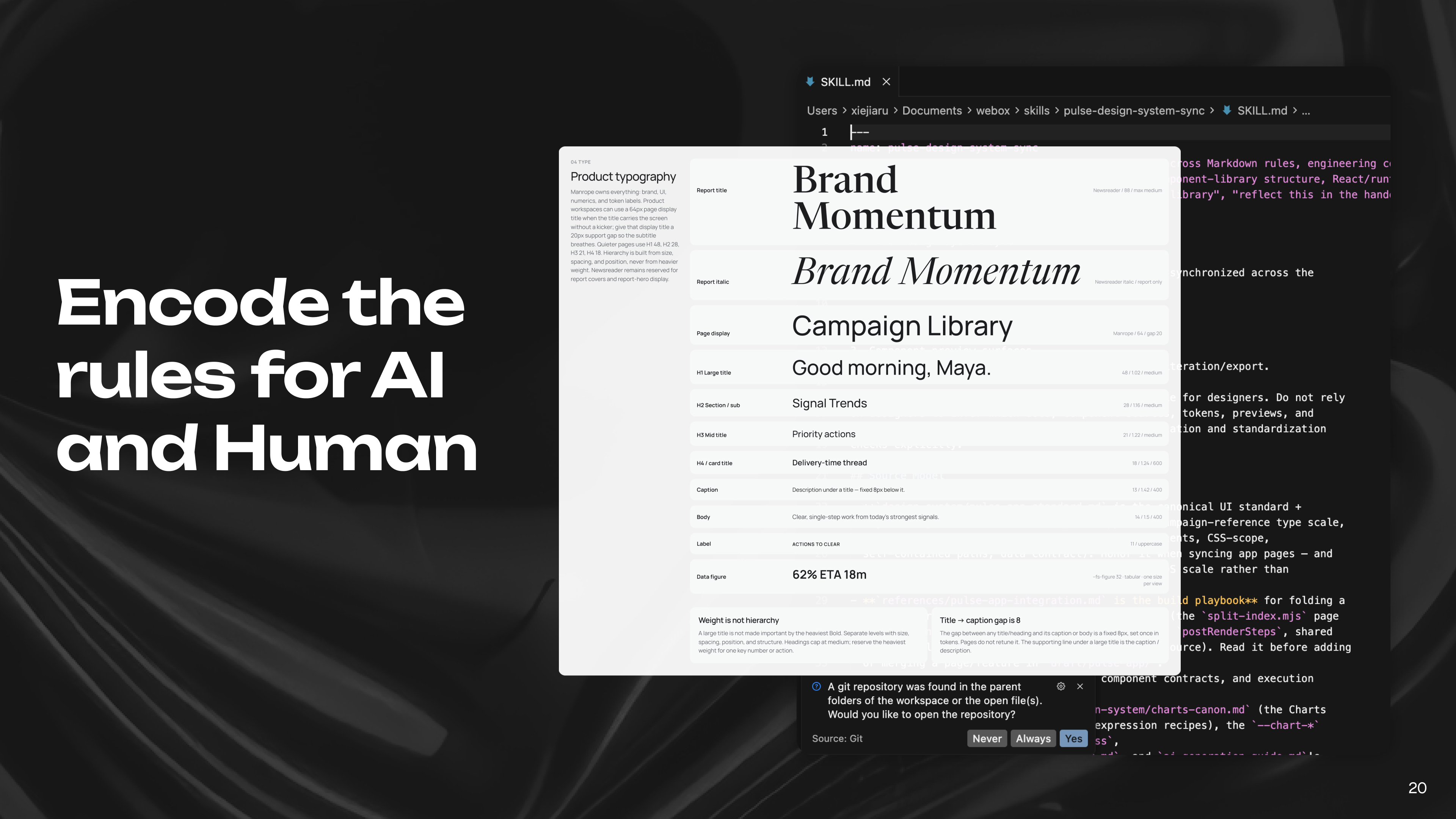
Encoding design rules for AI and humans
Design rules → AI-readable system → Working product

Chat message

Report section

Recommendation card

Navigation item

Identify
Normalize
Componentize

Chat/

Structure

States

Usage

Report/

Structure

States

Usage

Card/

Structure

States

Usage

Navigation/

Structure

States

Usage

Applied to

OnboardingStrategyCampaignsAnalytics

Recurring product decisions became reusable starting points.

Impact

From idea to working product, faster.

Working HTML prototypes built on the shared design system.

90%+

Prototypes delivered as working HTML

~60%

Faster design → prototype

~40%

Less manual UI work